In the world of electrification, advanced manufacturing, industrial automation, and deep technologies, technical innovation is often the most visible part of the journey.
However, many emerging technologies that demonstrate impressive technical capabilities never achieve meaningful commercial adoption.
The challenge is often not technology readiness itself.
More frequently, the gap lies between technology readiness and commercial readiness.
A solution can be technically impressive, yet commercially misplaced.
Before scaling investment, expanding engineering resources, or accelerating market expansion, emerging technology teams may benefit from validating several fundamental questions.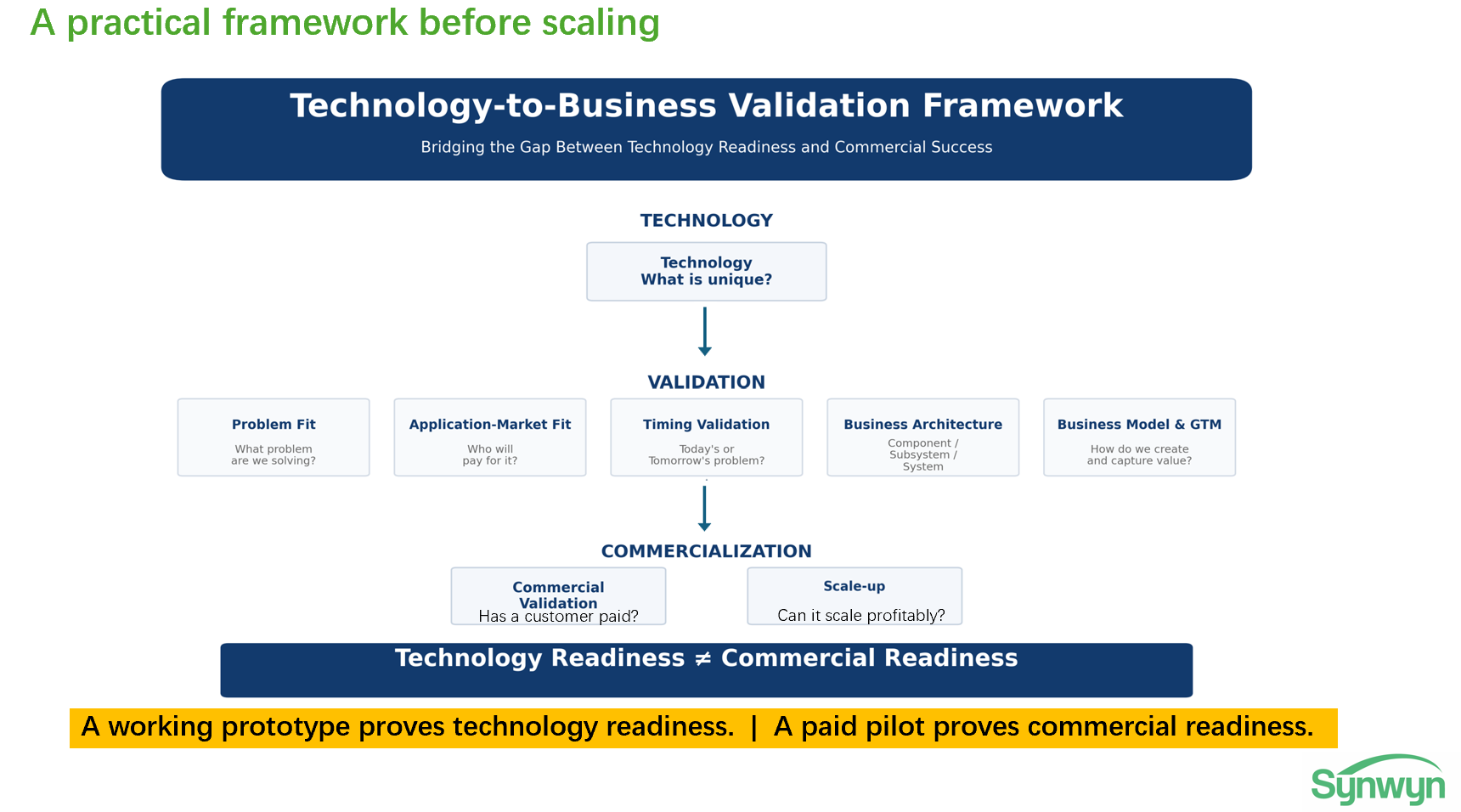
Many teams begin by asking:
What can our technology do?
A more useful starting point may be:
What problem are we solving, and where is that problem most painful?
Technology value is not absolute.
Its value depends on the application, the customer, and the specific problem being addressed.
Without a clearly validated problem, even highly differentiated technologies may struggle to gain commercial traction.
A technology may technically work across multiple applications.
However, only a subset of those applications may justify the cost, integration effort, operational risk, and adoption barriers associated with a new solution.
Before expanding product roadmaps or increasing engineering investment, it is important to identify where customers are both willing and able to pay.
Customers typically pay to solve problems they experience today.
They may appreciate solutions that address future challenges, but adoption often occurs only when those challenges become immediate and tangible.
This creates a common trap:
Technically relevant
Strategically interesting
Commercially premature
Understanding market timing is often as important as understanding the technology itself.
Technology value does not automatically translate into product value.
Organizations must decide whether they are delivering:
Components
Subsystems
Systems
Each approach creates different levels of differentiation, responsibility, integration effort, and value capture.
This is not only an engineering architecture decision.
It is also a business architecture decision.
A technically successful product still requires a viable business model and an effective go-to-market strategy.
Key questions include:
How is value created?
How is value captured?
Who influences purchasing decisions?
How will the solution be sold, supported, and scaled?
Technology alone rarely answers these questions.
A prototype proves technology readiness.
A paid pilot proves commercial readiness.
These are fundamentally different milestones.
Commercial readiness begins when customers demonstrate willingness to invest, deploy, validate, and scale the solution.
Once the problem, application, business model, and commercial value proposition have been validated, organizations can scale with greater confidence.
At this stage, industrialization, supply chain development, manufacturing readiness, and organizational growth become meaningful investments rather than speculative ones.
This framework is most useful before significant engineering investment, before expanding product roadmaps, or before entering new market segments.
It is especially relevant for B2B deep-tech innovations, where adoption cycles are long, customer validation is costly, and the gap between technical feasibility and commercial adoption can be significant.
The purpose is not to slow innovation down.
It is to help teams invest earlier in the right questions, so they can scale with more confidence later.
Technology Readiness ≠ Commercial Readiness
A working prototype proves technology readiness.
A paid pilot proves commercial readiness.
Emerging technologies do not succeed simply because the technology works.
They succeed when the business case, application fit, product positioning, and go-to-market model are validated early and rigorously.
✓ Start with the problem, not the technology.
✓ Validate application-market fit before scaling engineering.
✓ Distinguish today's pain from tomorrow's vision.
✓ Decide whether you are selling a component, subsystem, or system.
✓ Validate the business model and GTM strategy before assuming commercialization.
✓ Remember that technology readiness and commercial readiness are fundamentally different milestones.
Technology-to-Business Validation Framework v1.0
Synwyn Dynamics


